
Stop Hiding the Word “Psychedelic”
What nearly 3,000 posts taught us about social media censorship
P$ych3del!cs. MDM@. Ibog@!ne. For those of us in the psychedelic space, creative spellings like these are everywhere — dollar signs standing in for letters, periods breaking up words, sometimes entire captions written in a Wingdings-esque code that only the chronically online can decipher.
I've worked in social media and digital communications for over a decade, and for the last four years my team at set+setting has been hyper-focused on the psychedelic space. In that time, we've published, conservatively, about 3,000 posts on behalf of dozens of psychedelic organizations. And not once have I seen evidence that concealing these words protects anybody.
Our policy is the opposite. We write the word "psychedelic" plainly, and we name specific substances in both the graphics and the captions themselves. Psilocybin. MDMA. Ayahuasca. Ibogaine. In over 900 of those posts, ‘psychedelic(s)’ is present at least once in the caption. And across all ~3,000, exactly one has ever drawn a moderation response from a platform, and it wasn't because of the word "psychedelic."
If you take one thing away from this post: please stop hiding these words. It's doing more harm than good.
Why everyone writes "p$ych3del!c" in the first place
Let me start here, because the fear is not irrational.
People in this field have watched peer accounts get restricted, suspended, and removed, sometimes with no explanation and unsuccessful appeals. In May 2025, seemingly out of nowhere, Meta started taking down psychedelic accounts left and right, sometimes temporarily, sometimes permanently, with very little recourse. The account for the Psychedelic Science conference itself went dark for about a week before Meta reinstated it and called the removals a mistake. The Microdose documented the whole episode.
I'll be honest about how that period felt from the inside: I was bracing myself every time I opened a Meta app, waiting to see what fresh hell we'd be met with. There were moments I questioned my decision to build a business around psychedelic social media at all.
We had eight full-service psychedelic social media clients at the time. Across all of them, we had exactly one issue, and it was a strange one. No suspension, no violation notice, no slap on the wrist. Instead, any attempt to log into one client account from the Instagram app threw an error and crashed the entire app, locking us out of every other account too. We were uninstalling and reinstalling the app just hoping a login would take; one team member's phone was so thoroughly locked out of Instagram she had to run things from her iPad. Through all of it, the profile stayed fully visible to the public. And because the problem officially didn't exist, there was no appeals process for it.
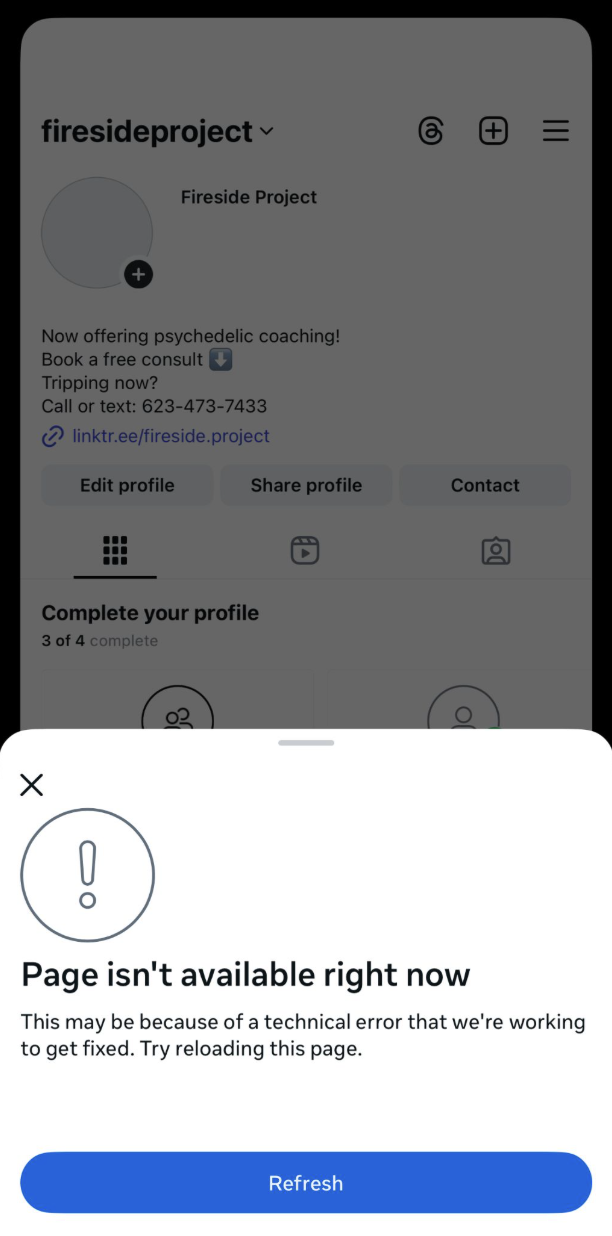
Screenshot of Instagram client account glitch, May 2025
I'm grateful we had strong relationships to lean on. We got in contact with the right folks at Meta, who connected us with a team that restored our access, and even they were surprised by what they found. It was a glitch they'd never seen before, not an enforcement action. Was it related to whatever was sweeping through psychedelic accounts that month? I suspect so, but I can't prove it, and neither could they. What I can tell you is that it was genuinely scary to watch my team's livelihood wobble at the whim of a social media platform’s algorithm.
The P$yc#3d3l!c workarounds grew out of real losses, and for a long time there was no data to check them against. It’s understandable why social media managers in the space choose to conceal the word: they’re navigating an environment without a clear roadmap.
Until recently, nobody had the vantage point to test whether the caution actually worked. We do — ten years in social media marketing, four of them focused on psychedelics — and that's why we're sharing our data. Because caution without data hardens into superstition.
Does hiding the word "psychedelic" actually work?
Someone tells me this at every conference: "You can't just write out 'psychedelic.' You have to disguise it."
And my response? “I have a large body of evidence that says otherwise.”
Conservatively, we've posted 3,000 times, the majority using the exact keywords people are terrified of, and not once has it cost us reach, a post, or an account.
Now think about what the workaround asks you to believe: that the algorithm can't tell the difference between an "i" and an exclamation point. Between an "s" and a dollar sign. That one swapped character can throw off some of the most sophisticated pattern-recognition technology on earth, built by a company pouring tens of billions of dollars a year into systems so precise that plenty of people genuinely believe their phones are reading their minds.
Reading text is the part Meta is good at. This is the same platform where coordinated networks of fake accounts have demonstrably distorted elections; systems operating at that scale are not confused by a dollar sign. And here's the simplest proof: if Meta wanted every mention of psychedelics gone, it would be gone. Our 3,000 plain-language posts would not exist. The word survives because the word was never the target.
Where Meta actually fails, and we'll get to this, is judgment, not detection. The same system that reads "p$ych3del!c" without blinking still can't reliably tell a harm reduction educator from a drug dealer. That's the real problem in this space, and no amount of creative spelling protects you from it. Concealment doesn't hide you from the machine. It just makes you harder to read for the humans you're trying to reach.
The practice has a name: "algospeak" — swapping letters for symbols or using euphemisms to route around automated moderation. A 2023 study in Social Media + Society interviewed creators about exactly this and found two things worth knowing: the practice is everywhere, and platform moderation is frequently inconsistent and flat-out wrong, especially about context (Steen, Yurechko & Klug, 2023). What the study can't tell you is whether concealing language actually protects your account. Our data can.
So can the field's own history: DoubleBlind, one of the most respected publications in this space, maintains a censored word list, obscures terms in captions, video, audio, and graphics, and has still had their Instagram account taken down entirely more than once, along with posts, ads, and videos removed across other platforms. They've been generous enough to publish a whole guide about it. Read it, and notice what it proves: the concealment was never the shield.
What our data shows: nearly 3,000 posts, only 1 flag
We're in an unusually good position to test this, because we may have the largest real-world dataset on psychedelic social media. From Spring 2022 through June 2026, we published nearly 3,000 posts across Instagram, Facebook, and LinkedIn for dozens of our clients, never concealing, blurring, or substituting a single psychedelic keyword.
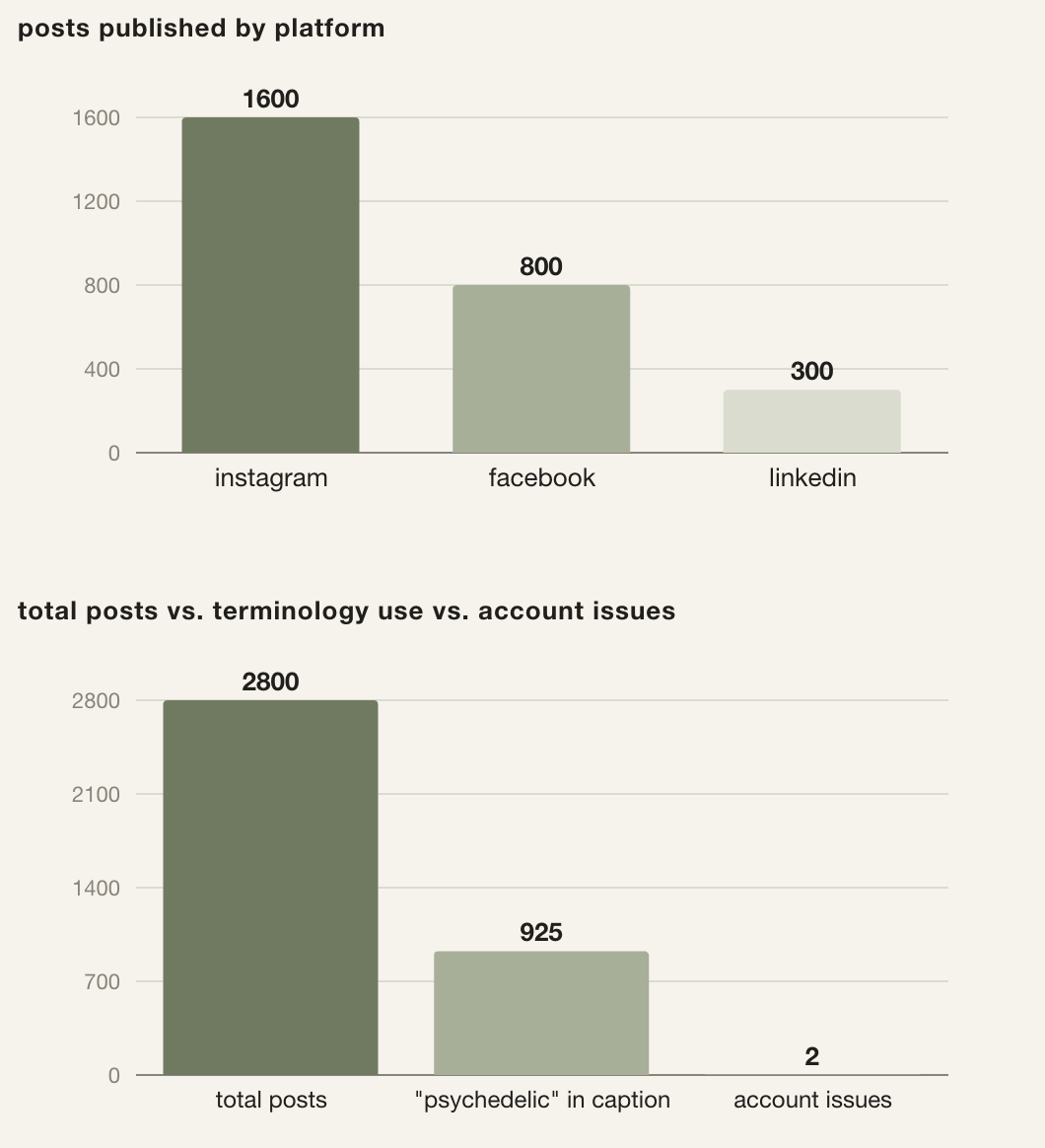
After four years and nearly 3,000 posts, exactly one* has ever been flagged by a platform's moderation system.
The bar is nearly invisible on the chart, which is sort of the point. And it wasn't flagged for the word "psychedelic,” more on that below. Meanwhile, accounts that do conceal their language have still been suspended, restricted, and removed entirely, DoubleBlind's history above being the most public example.
*How we measured this: The 900+ figure counts exactly one thing: posts whose caption contains the word "psychedelic," because caption text is the only thing reliably searchable at scale. It does not count other psychedelic keywords or substance names, including psilocybin, ayahuasca, MDMA, ketamine, ibogaine, 2C-B, and more, which appear consistently in our content but usually live in the graphics, the video itself, or the subtitles. None of these can be counted programmatically, so we chose to measure captions alone. Substance names appear in at least ~380 posts, but the true number is far higher. In other words: every count in this post is a conservative floor. The real volume of plain psychedelic language across our content is meaningfully greater than anything we can easily measure for the purpose of this writing.
"Fine, maybe they won't take your account down. But say those words and your reach gets throttled."
I hear this one constantly, so let's look at the most recent quarter. Not a cherry-picked golden one, just Q2 2026, on two of the accounts we've managed the longest, one since 2022 and one since 2023. Neither has ever concealed a word under our management.
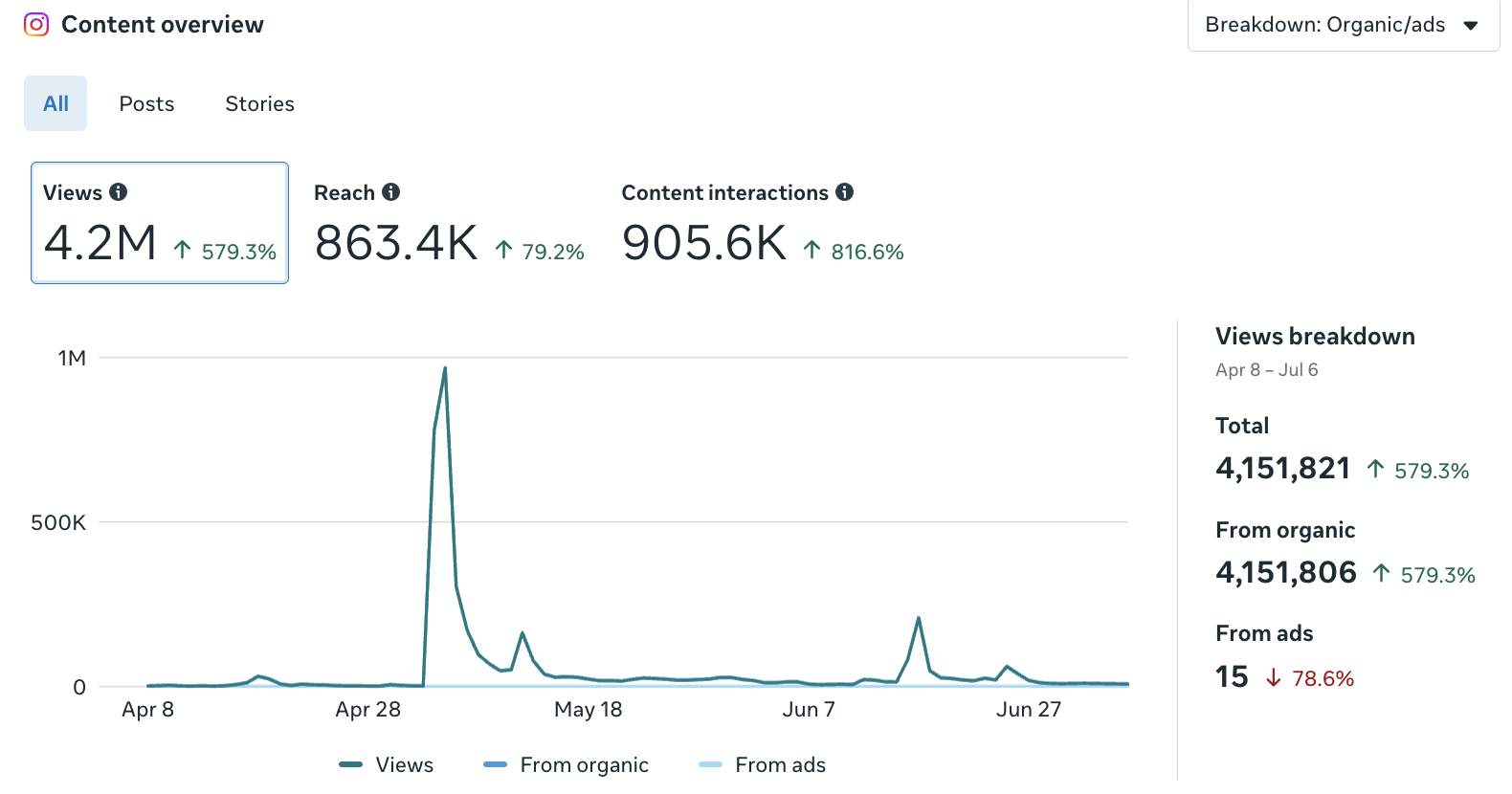
Views, Reach & Interactions on Instagram (shared with permission)
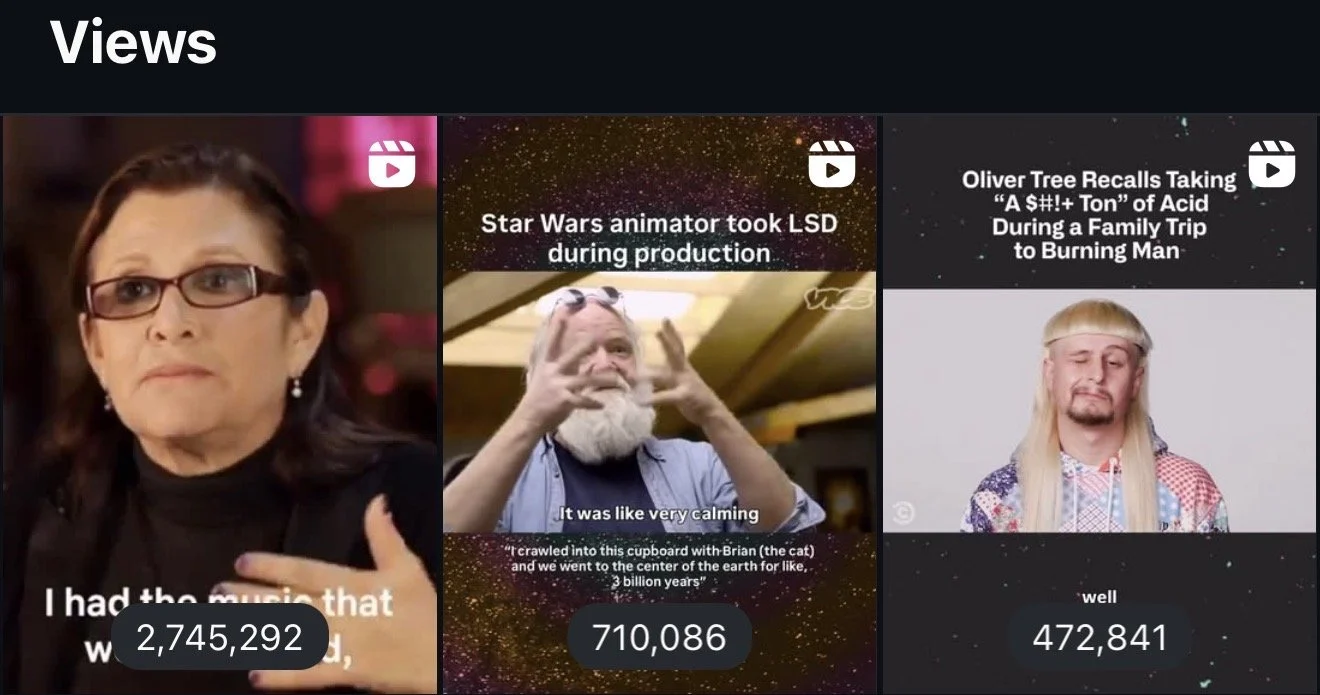
Views on Instagram (shared with permission)
The first earned 4.2 million Instagram views this quarter, up 597% from the prior period. Of 4,131,860 views, exactly 15 came from ads. Reach up 82%, interactions up 830% — essentially all organic. And the top content by views says the quiet words loudly: psychedelic keywords in the captions, the subtitles, the cover text, and the spoken content itself. A partner collab reel about Carrie Fisher and acid: 2.5 million views, 137,000 shares. A Star Wars animator on LSD: 708,000. "A family size serving of LSD": 471,000. Some were collabs, some posted natively from our account. No difference, no issues. If Meta throttled psychedelic keywords, our most explicit posts should be our worst performers. They are reliably our best.
These aren't outliers — see more of what this looks like across our clients in our case studies.
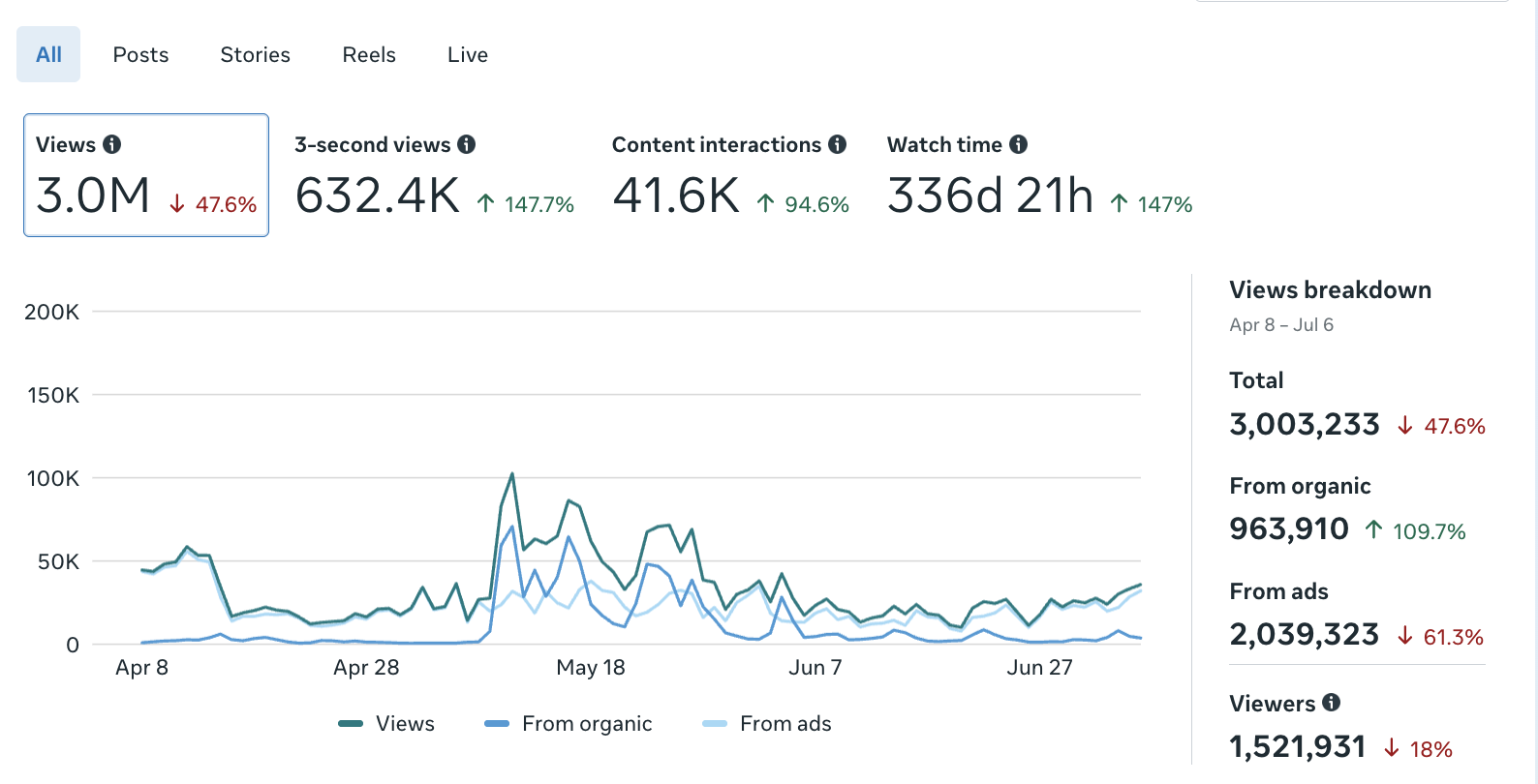
Meta data (shared with permission)
The second account covers the other version of this claim: that you can't use these words in ads, or that running them will tank your organic reach. Ads are run for this client using psychedelic keywords. Not only do they get approved, but they deliver. Same quarter: 3 million Facebook views, with organic views more than doubling even as ad spend scaled back. The account's top reel, built around a 60 Minutes segment, with "psychedelic" in the caption, the cover, the subtitles, and the video itself, earned nearly 1.4 million views across Facebook and Instagram.
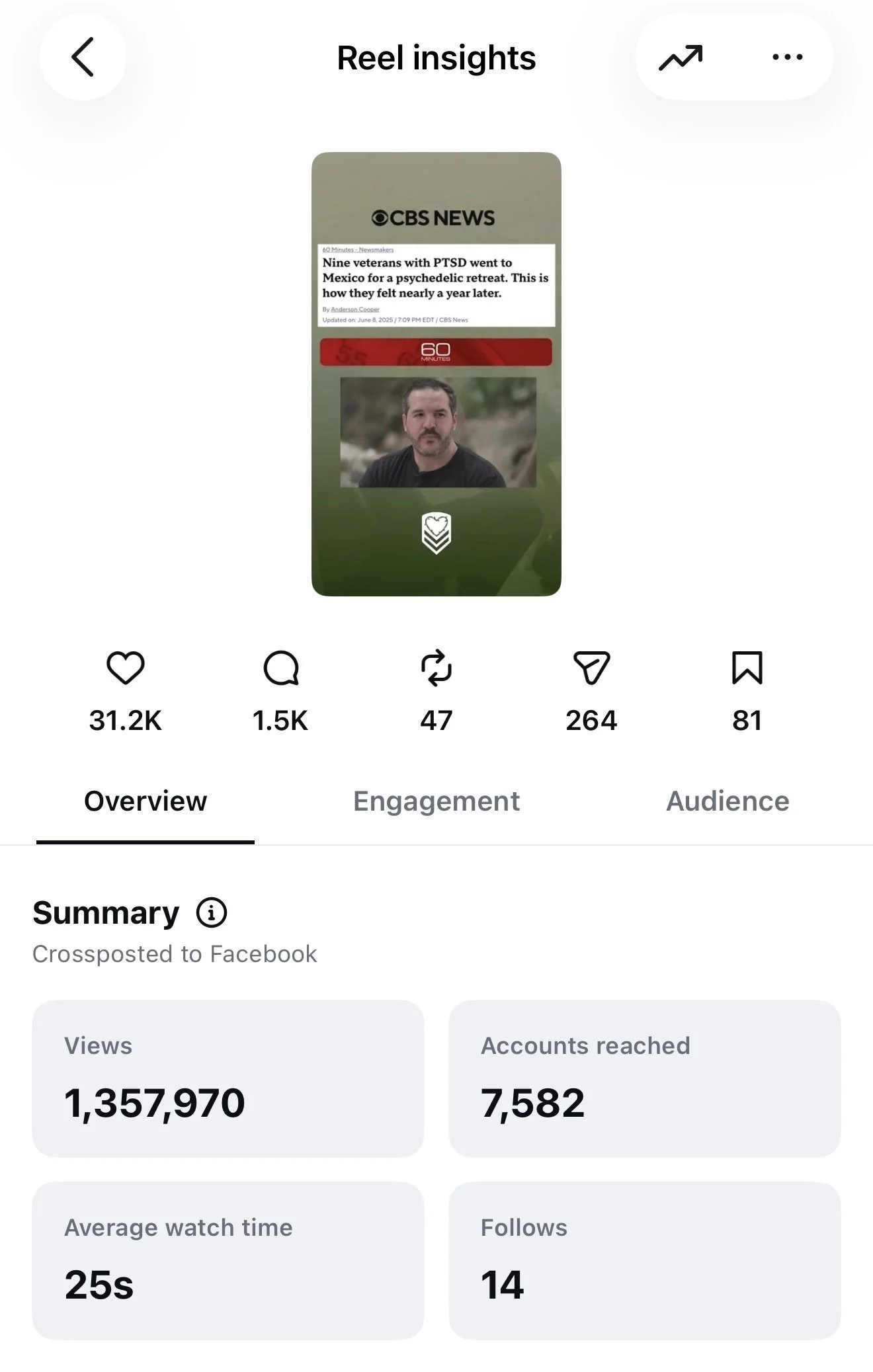
Instagram post data (shared with permission)
So the claim fails in both directions. Organic: millions of views with keywords everywhere and almost zero ad support. Paid: keyword-heavy ads approved and performing, with organic reach growing right alongside. I've never seen evidence for the reach-suppression theory, and a shadowban that lets you rack up millions of views is hardly a shadowban at all.
To be clear: I'm not defending Meta's moderation
Before we go further, let me be explicit about what I'm not arguing. For context: I have spent many years of my career inside Meta's platforms, and the most prominent framed photo in my office is the infamous Mark Zuckerberg Paddle Boarding in a Full Face of White Sunscreen. I keep it there for perspective, and to occasionally (often) shake my fist at. This is not a fan letter.
So believe me when I say: Meta's moderation is not fair, not transparent, and not working well. Educational accounts in this space have been removed with no warning and no explanation, appeals have been denied into the void, and the people it's hurt include exactly the harm reduction educators and Indigenous practitioners this movement most needs. DoubleBlind interviewed a former Meta employee who confirmed what many of us suspected: most of these takedowns are algorithmic, and the system genuinely struggles to tell the difference between someone selling drugs and someone teaching safety, a problem too niche for Meta to invest in fixing. Meanwhile, so many of us out in these psychedelic internet streets keep finding actual IG and FB ads blatantly selling drugs. The anger in this community is justified, and I share it.
My point is narrower, and it's the one our data speaks to: there is no evidence that the word "psychedelic" is what triggers the chaos, and no evidence that concealing it protects you from any of it. The chaos is real. The shield is imaginary. You can be furious at the system and still stop spending effort on a workaround that doesn't work and causes harm.
Why concealing language actively hurts
A huge part of the work my team does, and the movement so many of our clients fight for, is reducing the stigma around these substances. Concealing the word does the opposite. It treats "psychedelic" like a dirty word that has to be whispered. It signals that this is something shameful we're not allowed to say out loud. It pushes the whole conversation back into the shadows at the exact moment the field is working to bring it into the light.
There's a harm reduction principle here too. Calling things by their real names is how you communicate safely and effectively. Vague, coded, euphemistic language is the enemy of clarity, and clarity is what keeps people safe. If we believe in evidence and education, and we do, then we have to be willing to name what we're actually talking about.
What Meta's community standards actually allow
Here's the story of our one flag, because it's more instructive than any clean win.
In June 2026, we published an educational post about 2C-B. This is the kind of post we make all the time, on all sorts of substances, almost always with zero pushback, and they usually perform well and reach people who don't follow us. This one took off after being syndicated to our secondary platform Facebook, with over 100k views within the first 24 hours of posting. Soon after, we got a notice that the post would no longer be recommended to new audiences. Not removed, just limited.
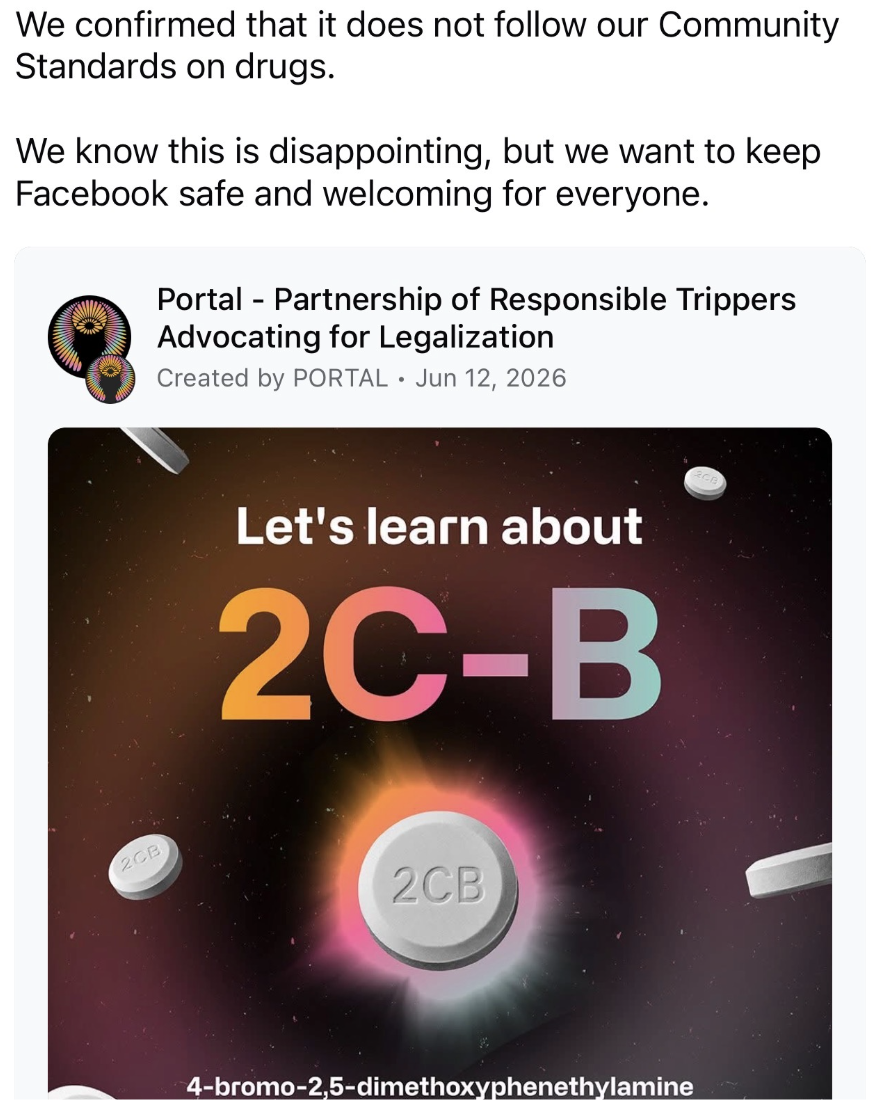
Meta notification (shared with permission)
My honest first reaction wasn't panic, but curiosity. We post substance education on this account constantly, so what was different about this one? The tell was in the numbers: this Facebook post massively outperformed its usual pattern, spreading fast and far beyond the account's existing audience. Nothing about the content was new for us. The reach was. Moderation systems pay more attention to content the moment it starts reaching large new audiences. Extra reach means extra scrutiny.
When we reviewed the official violation, the issue was clear: the post could be read as instructing people on how to use an illegal substance. We had approached it through a harm reduction lens: we never said anyone should take it, and we never implied there's a safe amount. But we had gotten specific about typical dosage and method, and that specificity is what drew the response.
And here's something I didn't expect to write in a post about censorship: the appeal process kind of impressed me. The violation notice was specific about what triggered it and what the appeal path was. I know exactly how rare that is. Plenty of organizations in this space have appealed into a void and never learned what rule they supposedly broke. But for once, the rules were written in a way we could actually navigate, a real improvement from the years when they felt intentionally vague and we were all just guessing. That maps onto Meta's own written policy, which now explicitly allows discussing the scientific and medical merits of these substances, advocating for legal change, and discussing their effects — there are even entheogen-specific guidelines baked right in:
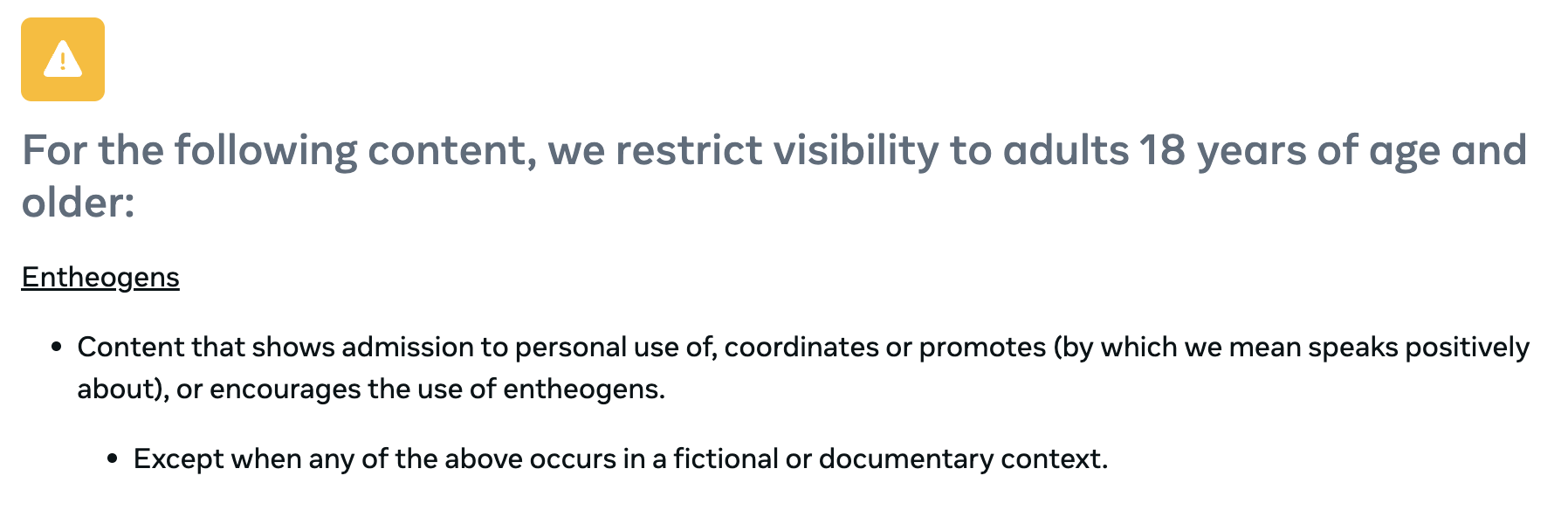
Screenshot of Meta’s Guidelines on Entheogens dated July 2026
According to the notification we received, our violation was related to ‘coordinating sales or providing instructions for use of drugs’. The updated policy shows that Meta is no longer putting educational content about LSD in the same bucket as someone trying to sell heroin to kids on Instagram. While I’m often a pretty harsh critic of Meta, I am here to give credit where credit is due and celebrate this as progress.
Naming the substance was never the problem. Getting into how-to territory was.
So we adapted our approach. We didn't want to lose the harm reduction value of dosing education, so our practice now is to frame risk without instruction: something like "dosage above X amount is known to be particularly dangerous" gives people real safety information without reading as a how-to. And for the explicit specifics, we now link out to the organizations built for exactly that. DanceSafe, for example, whose entire mission is detailed, evidence-based harm reduction information.
Then we did what every agency in this space should do: within the week, we briefed our other clients on the change wherever it was relevant to their content. One flag on one account became updated best practice across every organization we work with — and our clients' account health remained completely intact.
(One note for organizations working in clinical or medical contexts: if you're running trials or operating clinics, platform policy is only one of your layers. FDA and FTC claims rules, IRB sensitivities, and state regulators all sit on top of it. We’ve got plenty of experience with that as well, but that’s another blog post for another day.)
What about TikTok?
An honest caveat: our clients' work primarily exists across Meta and LinkedIn, so we don't have meaningful firsthand TikTok data, and we're not going to pretend otherwise. But the platform comes up a lot in this conversation, so here's what's documented.
TikTok restricts search results for some substance-related terms. Search "psychedelic" and you may get nothing but a notice that the word "may be associated with content that violates guidelines." To get around this, a user searching "psych3delic" might surface content that the real word won't. Creators in the Social Media + Society study describe navigating exactly this dynamic on TikTok, and it's real.
But let’s be precise about what kind of problem this is: a search-discoverability issue on only one platform. It is not evidence that concealing words in your captions protects your account, and on the platforms where we do have four years of data, plain language hasn't hurt account health at all. If TikTok search matters to your strategy, that's a targeted, platform-specific decision to make. It's not a reason to write in code everywhere you publish.
How we post about psychedelics
Here's what four years of evidence actually supports:
Name substances plainly. The platforms can read the code anyway, and plain language reaches real people.
Educate freely about effects, science, history, and policy. Meta's own rules permit this.
Frame risk without instruction. "Above X amount is known to be particularly dangerous" is an educational reframe of dosing instructions. Link to dedicated harm reduction resources like DanceSafe for the specifics.
Audit your strategy before blaming a shadowban. Most "the algorithm hates us" problems come down to content and strategy, not censorship.
One more thing, since we're being honest. My issue was never with the social media manager protecting an account she's responsible for, or the founder just trying to play it safe. I understand why concealing feels safer, but feeling safer isn't the same as being safer, and it comes at a real cost.
And it's not with the people who've documented their own scars, either. DoubleBlind built their censorship guide out of real losses, earnestly, to help others avoid the same fate. I cite them throughout this post because I deeply respect them and appreciate their reporting, and this field is better for their honesty and transparency. Saying "here's what happened to us" is testimony, and testimony is valuable.
My issue is with the leap that others have taken from testimony to commandment. The "trust me, you must conceal" that circulates through this field, delivered with an authority nobody earned and no data behind it. That's not caution, it’s fear-mongering. And this field, of all fields, should recognize the pattern. We know exactly what happens when people claim to know the way: the self-appointed shamans, the shady retreat-center charlatans, the influencers selling certainty. That same idolatry has crept into how we talk about digital communication.
So if someone tells you concealment is mandatory, ask them what they're basing it on. Rather than following gurus who claim to know the way, why don't we just look at the data? I'm happy to finally be able to provide some!
I first made this argument in a short video a few years ago, expecting it to disappear the way most posts do. It didn't. Recently, a leader at one of the legacy organizations in this space told me it changed how their team talks about their work, and that it helped them get comfortable being honest after years of feeling like honesty wasn't allowed. That conversation is why this post exists: I have a lot more evidence now than I did then.
We approach psychedelic science with care, precision, and evidence. We follow the data. We practice harm reduction, and we believe clear, honest communication is what keeps people safe. Psychedelic communications should be held to the exact same tenets — they were never separate things. The workarounds came from a rational place, but the data says we can let them go now.
Let's call things what they are.
It's safer, it's more effective, and it's the whole point.
FAQ / TL;DR
Can you say "psychedelic" on Instagram? Yes. In over 900 captions containing the word across four years, it has never caused a moderation issue for our clients. Meta's Community Standards explicitly allow educational and advocacy content about these substances (and even has a specific guideline section on entheogens).
Why do people write "ps*chedelic" or "p$ych3del!c"? The practice, called algospeak, grew out of real fear after accounts in this space were restricted or removed without explanation, including a documented wave of takedowns in May 2025. It was a rational response to an opaque system, but there's no evidence it protects accounts. Publications that conceal terms have still been removed and moderation systems recognize the substitution patterns anyway.
What actually gets psychedelic content flagged? Specific use instructions, particularly dosing amounts and methods of administration, and anything that could read as facilitating sales. Naming substances, discussing effects, sharing research, and advocating for policy change are all permitted under Meta's written standards.
Can you name specific substances like psilocybin or MDMA? Yes. We do it constantly, in captions and graphics, across nearly 3,000 posts. The substance name is not the trigger, instructional content is.
Methodology note: Data covers most active set+setting client accounts from March 2022 through June 30, 2026 — nearly 3,000 published posts across Instagram (~1,600), Facebook (~800), and LinkedIn (~300). "Moderation flags" counts every content-related platform moderation action across all accounts in that period: one, which did not involve the word "psychedelic." One additional account issue occurred due to a platform glitch unrelated to any post; the account access was later restored.
Lexie Tomchek is the founder of set+setting, a strategic communications agency serving psychedelic and mental health organizations. She has spent the better part of two decades in marketing and communications, the last four focused on the psychedelic field, where she leads communications for organizations including Fireside Project and drives social media and content for others like Heroic Hearts Project. Inquiries? Connect with us at letstalk@setsettingsocial.com.